
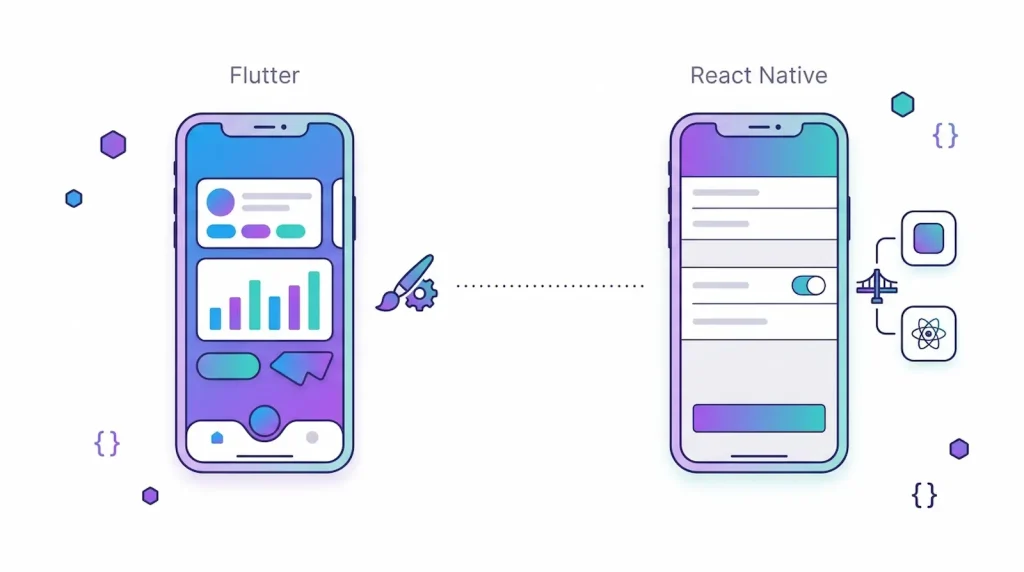
Choosing between Flutter and React Native is one of the first decisions enterprises face when planning a cross-platform mobile app — and it’s a decision with real long-term consequences for maintainability, hiring, and cost. Having shipped production apps in both frameworks, here’s how we actually make this call for clients.
The Short Version
Both frameworks let you ship a single codebase to iOS and Android with near-native performance. The real difference isn’t which one is “better” in the abstract — it’s which one fits your team, your existing stack, and your app’s specific demands.
Performance
Flutter compiles to native ARM code and renders its own UI layer independently of native platform components, giving it very consistent, predictable performance — especially for animation-heavy interfaces. React Native has closed most of the historical performance gap with its newer architecture (Fabric and the JSI bridge), but it still ultimately renders through native platform components, which means performance can vary slightly more depending on how a screen is built.
For most business apps — forms, dashboards, data-heavy screens — the difference is not noticeable to end users. For apps with complex custom animations or heavy graphics, Flutter tends to have an edge.
Development Speed and Team Skills
This is often the deciding factor in practice. React Native uses JavaScript/TypeScript — if your team already has web developers on React or Next.js, they can contribute to the mobile app with minimal ramp-up. Flutter uses Dart, a language most teams need to learn from scratch, but its widget-based architecture and strong tooling (hot reload, a single consistent design system) often make up for that learning curve within a few weeks.
If you have an existing JavaScript-heavy engineering team, React Native usually gets you to a working app faster. If you’re building a dedicated mobile team from the ground up, Flutter’s consistency across platforms can pay off over the life of the app.
Ecosystem and Long-Term Maintenance
React Native benefits from the enormous npm ecosystem and Meta’s continued investment. Flutter’s package ecosystem (pub.dev) is smaller but tightly curated, and Google’s release cadence has been very consistent. Both are mature, production-proven choices — neither is a risky bet in 2026.
One practical maintenance consideration: Flutter apps tend to need fewer platform-specific workarounds over time, since Flutter doesn’t rely on native UI components that can behave differently across OS versions. React Native apps sometimes need small native-side patches when a new iOS or Android release changes platform behavior.
When We Recommend Flutter
We built CarCare, a vehicle maintenance app, in Flutter — a good fit because the app needed a highly custom, consistent UI across Android with smooth animations and a tight visual design system, without an existing JavaScript team driving the requirements.
When We Recommend React Native
For an offline-first field operations app we built for an enterprise client, React Native was the right call — the client’s engineering team already worked in JavaScript/Node.js, and being able to share logic and conventions with their existing web stack sped up both development and long-term maintenance.
Our Decision Framework
When a client asks us this question, we walk through:
- What does your engineering team already know? Existing JS skills point to React Native; a clean slate opens the door to either.
- How custom and animation-heavy is the UI? Highly custom, animation-rich interfaces lean Flutter.
- Do you need deep native module integration? Both support native modules, but React Native’s larger ecosystem sometimes has a ready-made package where Flutter would need custom native code.
- What’s your maintenance horizon? Apps expected to run 5+ years with a small team often benefit from Flutter’s consistency.
There isn’t a universally correct answer — but there is usually a clearly correct answer for your specific team and app. If you’re weighing this decision for an upcoming project, we’re happy to walk through your specific requirements. Get in touch for a free technical consultation.