
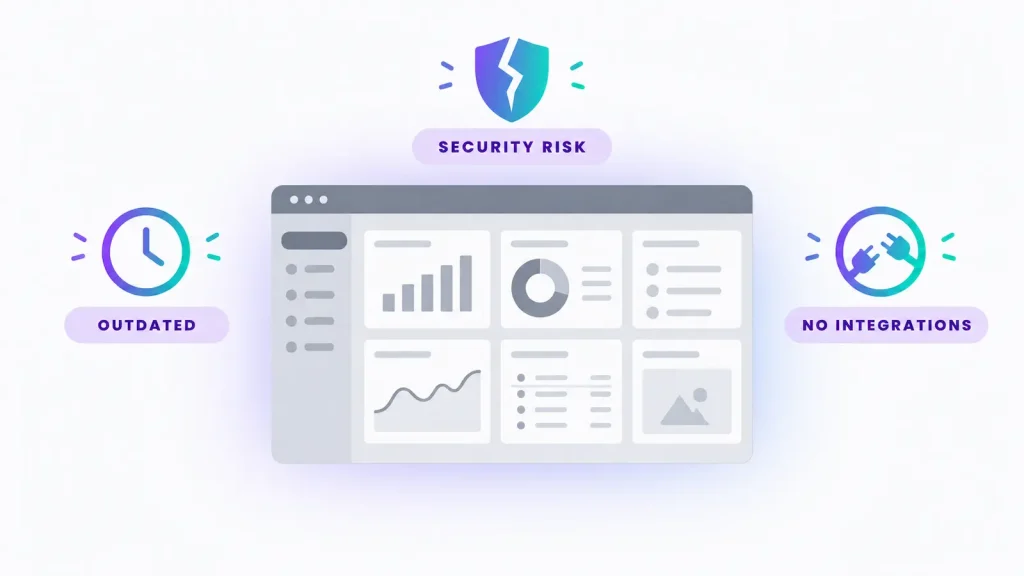
Enterprise portals rarely fail overnight — they degrade gradually, until the cost of staying put quietly exceeds the cost of upgrading. If you’re running an older Liferay Portal version, here are five signs it’s time to seriously consider a move to DXP.
1. You’re No Longer Receiving Security Patches
Older Liferay Portal versions eventually reach end of standard support, meaning newly discovered vulnerabilities simply don’t get patched. If your portal handles employee data, client information, or any authenticated workflows, running an unpatched version isn’t a theoretical risk — it’s an active liability that grows every month you wait.
2. Integrating with Modern Tools Feels Like a Fight
If your team is spending disproportionate effort connecting the portal to modern SaaS tools, mobile apps, or external APIs, that’s a strong signal. Liferay DXP’s headless REST APIs are built for exactly this — connecting cleanly to whatever your business is using today, not what existed when the portal was first built. Older versions typically rely on heavier, SOAP-based integration patterns that were reasonable a decade ago and are a genuine drag today.
3. Performance Degrades as Usage Grows
Older Liferay architectures are largely monolithic — scaling means scaling everything, even if only one module is under load. DXP’s OSGi-based modular architecture allows targeted scaling of the specific components experiencing high traffic. If every traffic spike turns into an infrastructure conversation, the underlying architecture is often the real constraint, not just server capacity.
4. You’re Struggling to Hire or Retain Developers for It
This one is easy to underestimate. Developers actively want to work with current technology — engineers experienced in maintaining legacy Ext plugins and Velocity templates are a shrinking pool, and the ones who remain command a premium. DXP’s more modern development model (OSGi modules, Freemarker, Clay UI, headless APIs) is a meaningfully more attractive stack for the engineers you’re trying to hire or keep.
5. The UI Feels Dated and Isn’t Properly Responsive
If your portal’s interface looks and behaves like it was designed for a different era of the web — heavy desktop-first layouts, inconsistent mobile behavior, dated visual design — that’s not just a cosmetic issue. It affects adoption, especially among newer employees or clients who simply expect modern web interfaces. DXP’s Clay UI component library and responsive-first approach make this a much easier problem to solve than retrofitting an old theme.
What to Do Next
None of these signs individually demand an immediate migration — but if two or three of them sound familiar, it’s worth a proper assessment before the gap widens further. We’ve written in detail about what a real Liferay Portal 6.2 to DXP 7.4 migration looks like, including timeline, process, and common pitfalls.
If you recognize your organization in this list, we’re happy to review your current Liferay setup and give you an honest assessment of scope, risk, and timeline. Get in touch for a free technical consultation.